
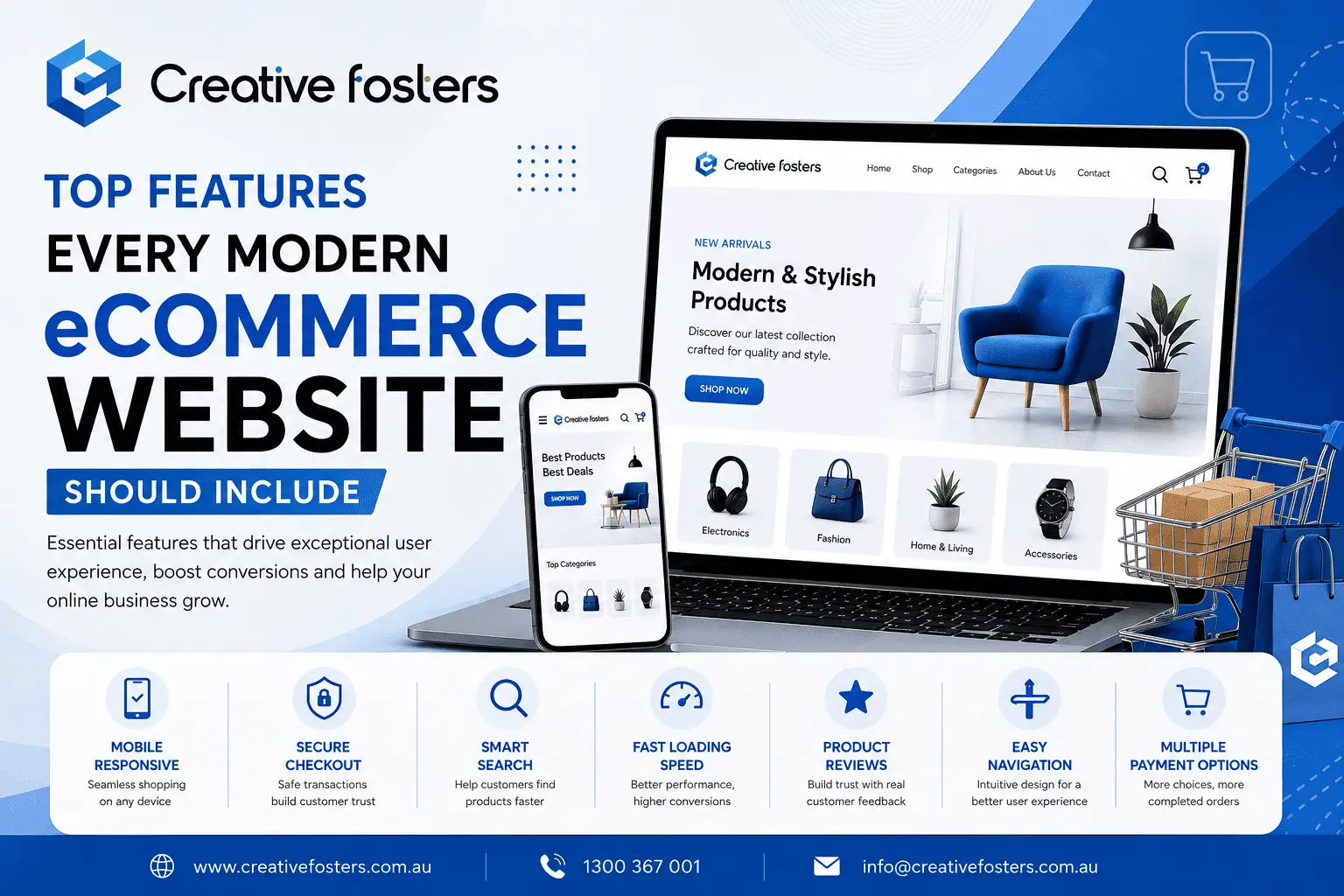
An efficient online store isn’t anymore a list of items for sale complete with shopping cart and checkout pages. These days, consumers demand speedy loading, intuitive navigation, safe transactions, informative content, personalization options, and an overall seamless buying process on all devices. The proper combination of these elements results in a more user-friendly and efficient eCommerce website in terms of conversion.
These essential eCommerce website features must be considered when developing an online store for companies who plan on building an efficient e-commerce website in Melbourne. It is necessary that the website design takes into account not only the needs of the consumer but also those of the business itself, such as acquiring organic traffic, product management, order processing, and conversion tracking. Below are some of these features that could greatly impact your store’s usability and performance.
What Makes a Modern eCommerce Website Effective?
In today’s world, an eCommerce website should be designed in such a way that it enables the buyer to easily find the right product, realize its value, buy it, and get all the relevant information at each step of the process. Designing does not only mean creating attractive colors, animations, or images. It means removing friction from each step of the customer journey.
Good ecommerce website design Melbourne consists of UX, responsiveness, performance, SEO, security, and conversion-oriented functionality. All these features should complement each other and not be considered separately.
It can happen that a website has an excellent appearance but performs badly since customers have problems with finding products or going through the whole checkout process. Conversely, the technically sound website may fail in sales due to poor product information.
1. Mobile-First and Responsive Design
Nobody wants to spend several seconds waiting for a product page to load. Slow websites can irritate their visitors, cause abandonment, and make the purchasing process difficult.
Modern shops need to optimize images and scripts, use effective hosting, and utilize browser caching, if possible. Optimized images are extremely important because online buyers require good images, yet bulky images can greatly slow down loading time.
It is also important to take performance into account during the template design and development. An experienced ecommerce website developer will know how to cut down unnecessary functionality and create good-performing pages.
2. Fast Page Speed and Strong Core Web Performance
No one wants to wait several seconds while loading a product page. Such websites can drive users crazy and increase abandonment rates, as well as make it difficult for clients to buy anything.
It is recommended for the modern store to optimize image size, delete unnecessary scripts, choose good hosting, and implement browser caching when it is appropriate. The images of products are particularly important because online buyers need high-quality pictures, and large images influence loading time greatly.
Performance should be thought about during template creation and development too. The right web developer who specializes in ecommerce websites will understand unnecessary functions and create pages with proper experience.
3. Clear Product Categories and Simple Navigation
The customer should not be left guessing the location of the product he is looking for. Navigation will guide the customer in moving from general categories to specific products without going through many click-throughs. It is advisable to develop a navigational system that matches how customers look for products. Filters can assist customers in narrowing down the results based on various characteristics, including price, size, color, brand, material, or availability.
It is also important to have a search function for bigger stores. The best search engine should be able to interpret product keywords used by customers even if the actual product names are not used. When it comes to ecommerce website design in Melbourne, it is important that navigation assists in SEO through a logical relationship among the categories, subcategories, and the products.
4. Detailed and Useful Product Pages
A product page must contain answers to those questions which the consumer asks prior to making the purchase. Quality photos, descriptions, technical information about the product, pricing, and delivery information are what build up purchase confidence.
The use of various images, zooming ability, video demonstrations, size guides, and comparison information where necessary should be present on product pages. Reviews and FAQs will help solve those problems which might hinder the customer’s purchase process.
Product descriptions should highlight not only technical information about a product but also its benefits to the customer. The description of a product feature will be much more helpful than just listing it among other features.
Such an approach plays a vital role in e-commerce website design in Melbourne since quality product pages serve two purposes: they help customers to make decisions and give valuable content to search engines.
5. Smart Product Search and Filtering
With a growing online shop, internal search becomes especially vital. A customer looking for a certain item must get relevant results in no time. The advanced search can consist of suggestions and autocorrect of typos, recommendations, and the corresponding categories. Filters should update the results without forcing a person to reload the whole page.
If there are hundreds or thousands of items in a shop, then navigation by facets would help a lot. But this feature needs to be installed carefully as faulty filters may cause duplication of URLs and other SEO issues. An experienced ecommerce website developer will be able to organize search and filtering in such a way as not to cause extra difficulties.
6. A Simple, Low-Friction Checkout
Checkout is one of the key steps in the eCommerce process. Consumers that have chosen an item can still leave their shopping cart behind due to difficulties at the checkout process.
Today’s checkout should not include any excessive questions, but on the contrary, it should provide clear information regarding shipping, taxes, payment options, and the total cost of the order. Guest checkout may prove useful when shoppers don’t want to make an account prior to making a purchase.
Also, checkout design should let the consumer know exactly which step he is at. Instead of a general error message, it should tell him what to fix. Good ecommerce website design in Melbourne should focus on converting the consumer rather than making him fill out a form.
7. Multiple Secure Payment Options
Not all customers use the same payment methods. The online shop can choose whether it will accept credit cards, e-wallets, bank-related payment solutions, buy now, pay later or some other secure gateways.
It is important to be careful while working with payment data. The site has to use HTTPS, work with trustworthy payment partners and comply with all security and privacy regulations. The payment methods must also be clearly described during the checkout process. Restrictions or additional fees related to payments can scare off potential buyers.
8. Customer Accounts and Order Management
There may be other benefits provided by customer accounts, aside from simply storing login details. According to the kind of business being run, the user may have access to their purchase history, shipping updates, saved address information, payment methods, or wish lists.
On the other hand, an account system should not be unnecessarily imposed. A good store will allow guest checkout, as well as a way for the customer to easily create an account after their purchase. The order management system must also send customers confirmation e-mails and status updates.
9. Product Reviews, Ratings and User-Generated Content
Many people try to find proof in the form of feedback from other buyers before making any purchases. Feedback and ratings are a form of social proof that can help consumers learn about the true performance of a product.
It is important for a good review system to allow consumers to post their reviews easily. Businesses can even request customers to post pictures or other forms of user-generated content when needed. Reviews are not just a tool to convert prospects. They can also offer insight into common customer concerns and issues with products.
10. Personalised Recommendations
Personalisation can be useful to an online store when done in a proper way. Websites can suggest products that go well together, products viewed before or accessories depending on what users have been viewing or purchasing.
For instance, a user purchasing a camera can be offered memory cards, batteries or camera bags among other products that complement the purchase. The personalisation should still maintain relevance, especially when dealing with customer data. The goal should not be to present more products to customers but to make shopping easier.
Final Thoughts
An ideal ecommerce website today must offer more than just showcasing products. An ecommerce website today should facilitate discovery of the requirements of the consumers, educate them on the various options available to them, provide them confidence when making purchases, and deliver a consistent experience post-checkout.
The best ecommerce website design in Melbourne is designed from a customer perspective but at the same time offers businesses a functional framework for growth. The specific features used in the designs may vary based on industry and the target demographic; however, the underlying philosophy always remains the same: everything in the design of the website should enhance the shopping experience and achieve some business objective.
For businesses that are looking to build the next-generation ecommerce website or even enhance the existing one, Creative Fosters offers a pragmatic approach towards ecommerce website development that delivers websites built with real users and search optimization in mind.
