
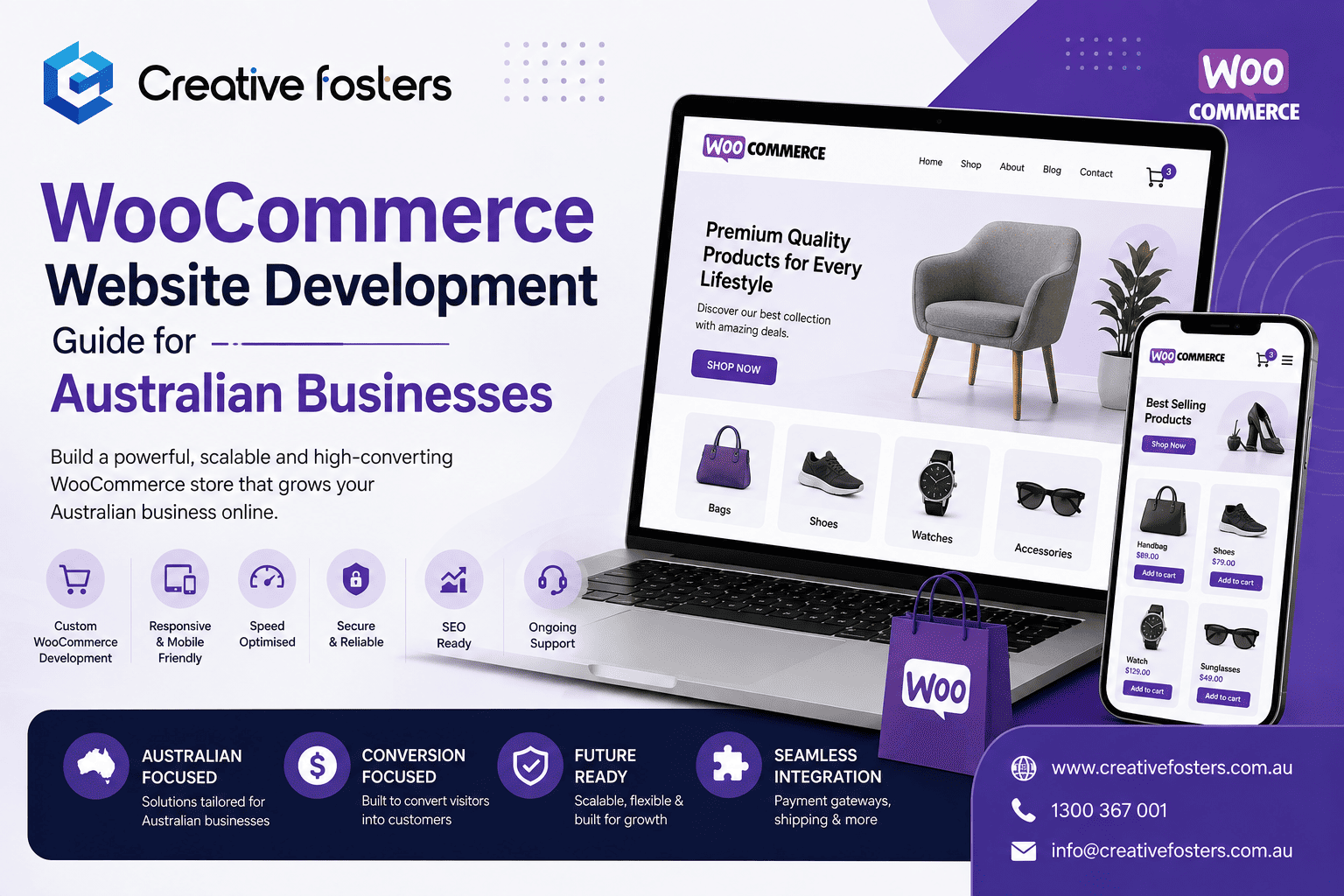
When it comes to selling products online, the choice of an ecommerce platform is essential for every business in Australia. The website not only has to showcase the products but also should facilitate the purchase process, be equipped with secure payment options, have excellent mobile performance, fast loading speed, and be flexible enough for you to manage products and orders without unnecessary hassle.
Here, WooCommerce Website Development may prove useful. WooCommerce is a platform developed for WordPress that enables businesses to transform their ordinary WordPress site into an ecommerce site. This solution may cover everything from simple product catalogues to complicated ecommerce platforms with various payment options, shipping, customer accounts, and other capabilities.
What Is WooCommerce Website Development?
WooCommerce Website Development is the development of an online store with the use of WooCommerce and WordPress. WooCommerce supplies the e-commerce capabilities, whereas WordPress serves as the content management system. In this way, businesses have the opportunity to implement such aspects as product pages, shopping carts, checkout process, customers’ accounts, order management capabilities, and others related to ecommerce.
As compared to a regular website, the ecommerce site includes some different components that are interconnected. It is important to format the information about the product in a proper manner, manage the inventory, secure the payment process, calculate the delivery cost, and make the checkout process easy for the customers. That is why effective WooCommerce Website Development is not simply the installation of a plugin and adding the products.
Why Are Australian Businesses Choosing WooCommerce?
Flexibility is another benefit associated with WooCommerce. Businesses are able to begin with a fairly basic store and build up on it as their needs evolve. For instance, an Australian company would have the ability to start off with basic features such as pages, payments, and shipping and then require more sophisticated features like inventory management, accounting, customer segmentation, subscriptions, and third-party integration as sales grow.
It is possible to integrate such needs into WooCommerce by installing extensions, performing integrations, and implementing custom work. Control is yet another benefit because WooCommerce works within the WordPress platform, which gives businesses the freedom of managing their content and site functionality. It can be quite useful when a company wants to use WooCommerce as the basis for both its ecommerce and content marketing strategies.
What Should You Consider Before Starting a WooCommerce Project?
Steps towards successful WooCommerce Development begin even before design and code are involved. First, you need to understand what the store must achieve. It is essential to identify the nature of the goods that will be sold in the store, the variety of items, the target audience, shipping destination, payment methods, and the expected volume of orders. In addition, there is a need to consider whether the clients require an account, a subscription, product comparisons, wish lists, and so forth.
Australian businesses also need to consider GST and pricing presentation. Tax settings, product pricing and invoices should correspond to those used in the firm’s accounting system. Another significant issue is shipping. Australian businesses that operate online may sell their goods within metropolitan, regional, and remote regions where the cost of delivery and time spent might be significantly different. Thus, a WooCommerce store should contain shipping options which would correspond to the real delivery process.
How Does the WooCommerce Website Development Process Work?
1. Planning the Ecommerce Store
The first step is comprehending the business and its customers. In this regard, one needs to analyze the current website, product catalogues, competitors, customer journey, and other necessary requirements.
Any sensible strategy requires defining the website architecture before the development process starts. Categories, subcategories, filters, and navigation need to be logical for the customers and search engines. This phase is especially important for big stores. Poor architecture leads to a difficult search process and SEO issues in the future.
2. Designing the User Experience
Design should help people buy, not look nice. It must let a person know what the company sells. They should see how a product can fit their needs and what to do next. Pages that list products must show details such as specifications, price, stock, pictures, shipping details and FAQs.
Mobile usability must be a priority because many people shop on phones. Buttons, photo galleries, menus, forms and checkout pages must all work smoothly on devices.
3. Developing the WooCommerce Store
After the structure and design are approved, developers build the website using WordPress and WooCommerce. Developers can configure product types, categories, attributes, variations, carts, checkout functionality, customer accounts, and order management.
Depending on the project, WooCommerce Website Development may also involve custom functionality. For example, a business could require a product configurator, wholesale pricing, customer‑specific pricing, complex shipping calculations, or integration with an inventory management system.
This is where Custom web development services can become valuable. Instead of forcing the business to work around the limitations of an off‑the‑shelf solution, custom development can create functionality around the company’s actual processes.
4. Integrating Payments and Shipping
Payment and shipping are the heart of any ecommerce store. Australian businesses can set up WooCommerce to use the payment gateways and payment methods that work best for their customers and their own business needs. I believe the checkout process must show the cost of the purchase very clearly before a customer finishes the transaction.
Shipping needs to be just as easy to use. Customers should be able to see what delivery options are available. Customers should also know how much the delivery costs. If you can, when the order will arrive. Testing is a must at this stage. You should test products, different quantities, different customer locations, and different payment scenarios. Testing these things helps you find any calculation or checkout issues before you launch your store.
What Features Should a WooCommerce Store Have?
I do not think there is one list of features that works for everyone. This is because every ecommerce business works in its own way. Still, I believe every core store must make it easy for people to find products and buy them. You should not just paste text from the manufacturer. Instead, product pages should have helpful descriptions. High-quality images, product specifications, availability information, and clear calls to action all help customers decide what to buy.
As your catalogue grows, search and filtering become more important. If a store only has 20 products, people can browse that easily. If a store has thousands of products, that store needs better navigation and filtering to help people.
Customer accounts are also great because they make repeat purchases much easier. With customer accounts, shoppers can look at their orders, save their info, and manage their details. If you sell items that come in different sizes, colours, materials or configurations, WooCommerce variations can help you show those choices in an organized way.
How Important Is Website Security?
Security must always be a priority in WooCommerce Website Development. I believe that an ecommerce website must protect information such as customer details, addresses and payment data. I insist that WordPress, WooCommerce, themes and extensions must stay updated and configured correctly.
Security can be strengthened by hosting, HTTPS, strong administrator credentials, proper access controls, regular backups and security monitoring.
I advise businesses to review every plugin and extension on their website. Each additional plugin may create maintenance needs. If poorly developed or outdated may bring security or performance problems.
How Can WooCommerce Be Integrated With Other Business Systems?
A major advantage of WooCommerce is its compatibility with other applications. Depending on the nature of the business, there will be a need for an ecommerce platform to work together with accounting software, CRMs, inventory applications, email marketing software, marketplaces, or logistics providers.
In some cases, the process will involve receiving an order from WooCommerce, passing it to the inventory application, recording it in accounting software, and finally passing it to the fulfillment provider. Such a process can be automated to enhance efficiency. If the standard integrations are not enough, it is possible to use custom web development services to come up with the right integration.
What Are Common WooCommerce Development Mistakes?
Choosing plugins based on the number of features they provide is one common mistake. The more plugins you install, the less maintenance your website. Checkout being an afterthought is another thing. Customers usually spend some time studying a certain product; however, if the checkout process is complicated, long, or expensive, they will most likely refuse to buy the product.
Another common mistake is weak product content. As for ecommerce websites, their purpose is to give customers information about the product and its features. Thin descriptions, lack of specifications, and unclear delivery info create confusion. Another important point is not planning ahead. Your store may function great when it contains 50 items, but what happens when it reaches 5,000?
How Much Does WooCommerce Website Development Cost in Australia?
The cost will vary greatly based on the magnitude and complexity of the project. A small shop with an average product list will not entail the same amount of development time as a big ecommerce site with a custom design, advanced filtering, ERP system, subscriptions, wholesale functionalities or complicated products to be listed.
The budget for development will also account for hosting services, premium extensions, payment gateways, support, security, content generation, and SEO.
Rather than focusing on getting the cheapest project in terms of cost alone, companies should evaluate the total cost of ownership. A cheap solution which will need to be completely rebuilt could end up costing more than the right solution.
What Makes a WooCommerce Store Successful?
There are various components required to create a successful ecommerce site. A functional website requires valuable products, accurate information, reliable technology, and a purchase process that is easy to follow without external help.
Effective WooCommerce Website Development must cater to both the visitor and the staff running the website from behind the scenes. The staff must be able to modify products, fulfill orders, and control information without any technical difficulties.
Furthermore, the website must be analyzed after its creation. Information about the source of traffic, popular products, as well as the areas of exit during the purchase process, can all be found through analytics, Search Console, conversions, and ecommerce reporting.
Final Thoughts
For Australian companies, WooCommerce is a good choice as a flexible framework for creating an ecommerce website which will evolve together with their business.
The main thing about WooCommerce Website Development is to think about this process as about the whole business project instead of installing just another website. Careful planning of the customer flow, product structuring, payments and shipping configuration, paying attention to security, SEO optimization and scalability can have an impact on the final outcome of the process.
Where standard capabilities do not meet the needs of the business, Custom web development services can be used for the development of unique features needed by the company. For Australian companies willing to create an e-commerce website or improve the existing one, cooperation with a professional development team like Creative Fosters can help to implement all the requirements in terms of a real-life business process.
